Pavers vs Stamped Concrete for Commercial Spaces: Cost, Lifespan and Liability
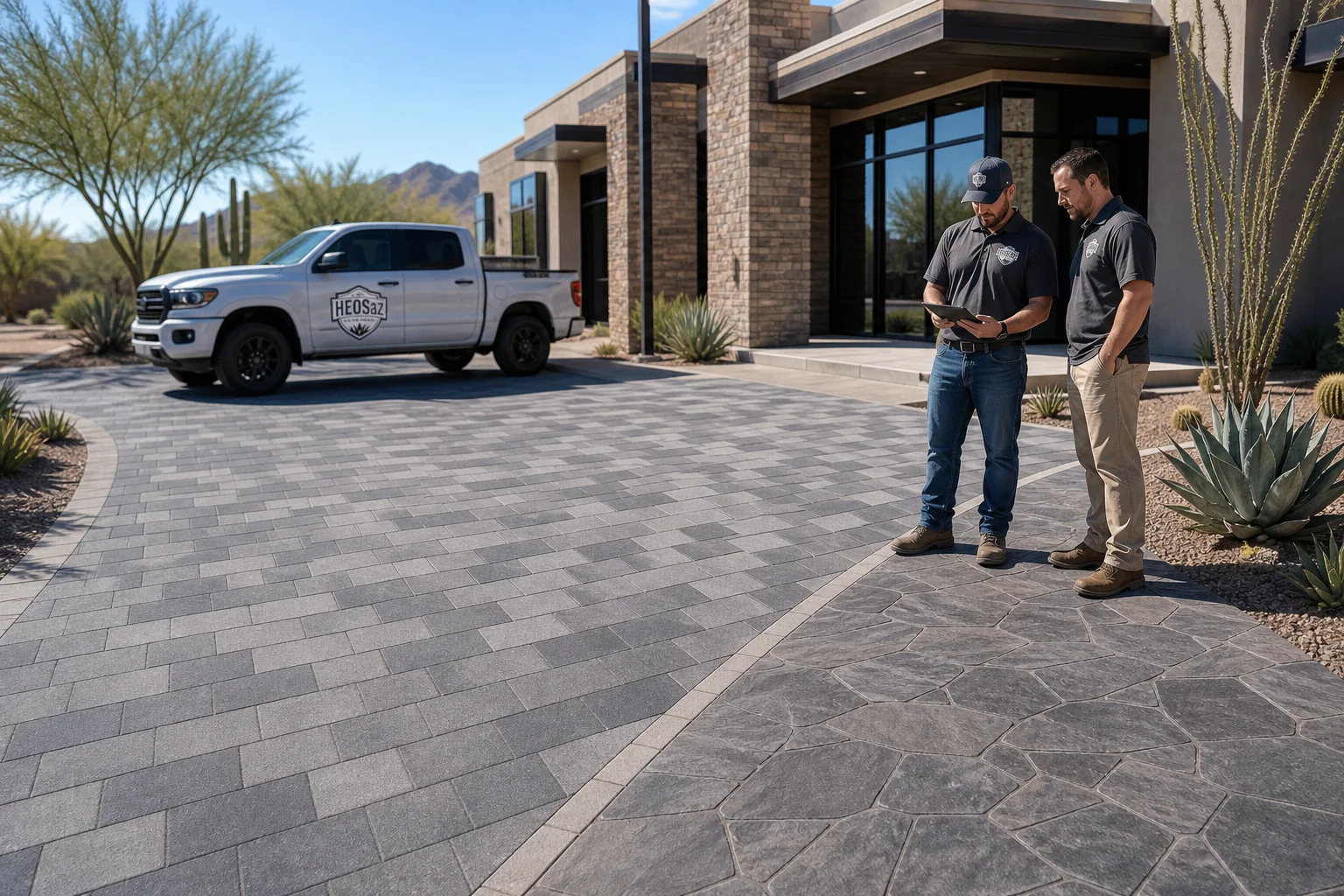
Choosing between commercial pavers vs concrete affects your property's upfront budget, its ten-year maintenance bill, and your liability exposure if a slab cracks into a trip hazard. For HOA boards, property managers, and business owners weighing Hardscape upgrades, the right surface depends on traffic load, climate, and how the property plans to handle repairs over time.
By HEOS AZ Team, Outdoor Living Specialists
Cost and Installation Timelines: Commercial Pavers vs Concrete
Property managers comparing commercial pavers vs concrete usually start with the bid sheet, and the two systems build their costs from different line items.
What Drives the Installation Cost Structure
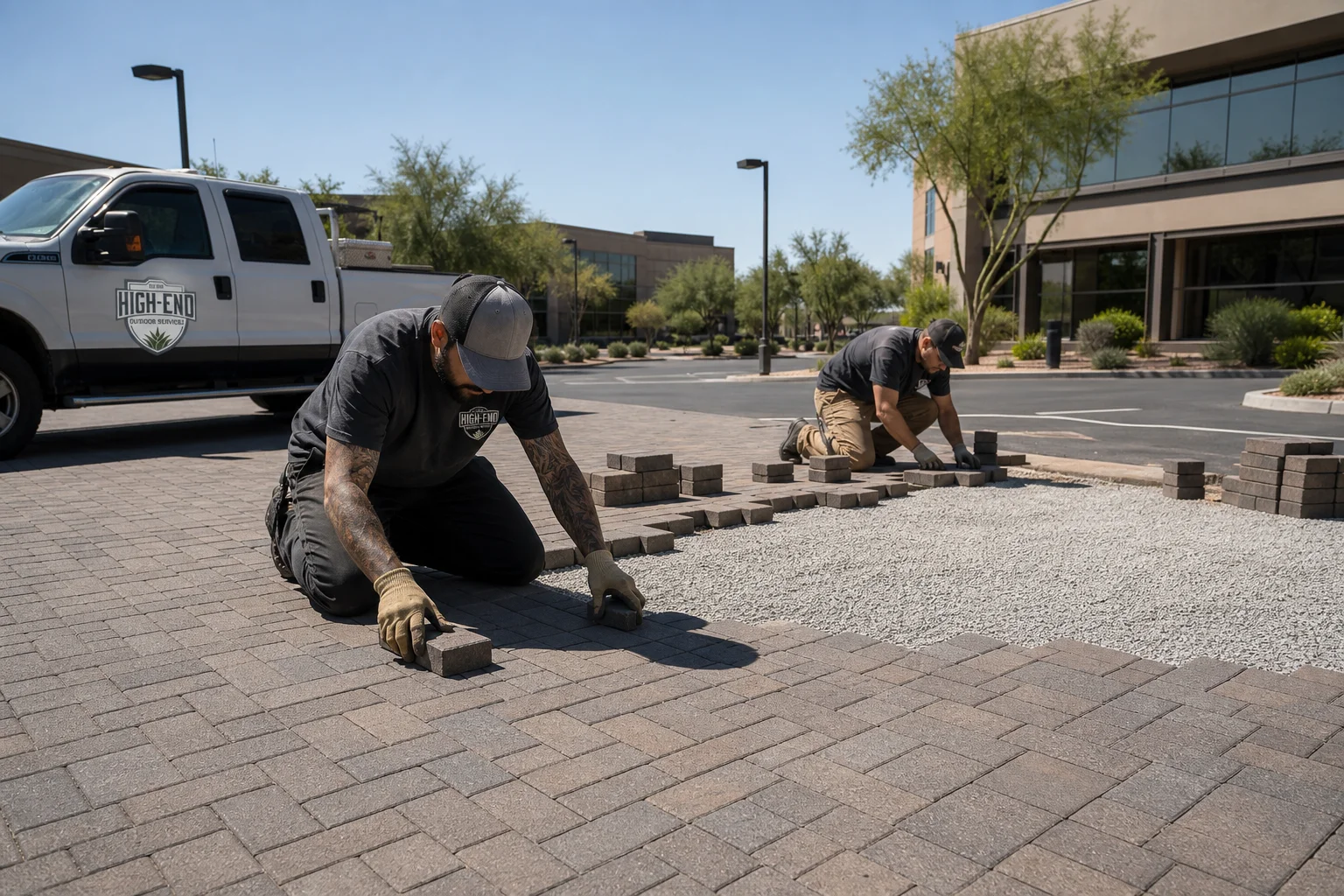
For concrete pavers, the total is built from the compacted base, the paver units (color, finish, and thickness all move price), and labor to cut and set units around drains, columns, and curbs. A lot with dozens of tight radii or drainage inlets costs more per square foot than a flat loading area, since labor scales with the number of cuts, not square footage alone. Some manufacturers also produce stamped concrete pavers, textured units that mimic a poured stamped finish while staying separately replaceable, worth asking about if you like that look but want paver-style repairs.
Stamped concrete works differently: the base cost covers the pour, while stamping, coloring (integral color mixed into the batch versus a surface-applied release agent), and sealing are typically billed as add-ons. A property choosing stamped concrete for a large plaza should expect finishing labor, not the concrete itself, to be the line item that moves the total most.
Excavation and base prep are almost always part of either bid; sealing, joint sand, and drainage rework are what most often surprise a property manager afterward. Both are proven commercial materials when installed correctly, but the right answer for one project may not fit the next. Ask your contractor to itemize base depth, material grade, and whether sealing is included in year one, that question alone prevents most post-installation disputes.
Installation Timeline and Business Disruption
Concrete pavers can typically open to light foot traffic within a day of the final unit being set, since there is no cure time, only a joint-sand settling period. Stamped concrete needs a full cure before it can bear vehicle loads, which usually keeps a lot or drive lane closed for close to a week depending on weather and mix design. For a property that cannot close an entrance or parking section that long, pavers are often the lower-disruption choice, with sections reopened in phases while Paver Installation continues elsewhere on site.
Lifespan and Durability Under Heavy Traffic
Concrete pavers, installed over a properly compacted base, commonly last several decades because each unit distributes load independently and can be reset if the base settles. Stamped concrete is a single continuous slab, so its lifespan depends heavily on how well the sub-base was prepared and where control joints were placed. A slab poured over inconsistent soil, common across the Phoenix area's expansive clay pockets, may need attention before a comparable paver system would.
Under repeated heavy vehicle traffic, such as delivery trucks crossing the same path daily, pavers tend to hold their surface profile because each unit flexes slightly with the base rather than transferring stress across one rigid plane. Stamped concrete performs well under distributed foot traffic but is more sensitive to concentrated point loads, a repeatedly parked forklift or dumpster corner, since stress has nowhere to go but into the slab. Knowing which material holds up under sustained loading helps avoid repeat repairs.
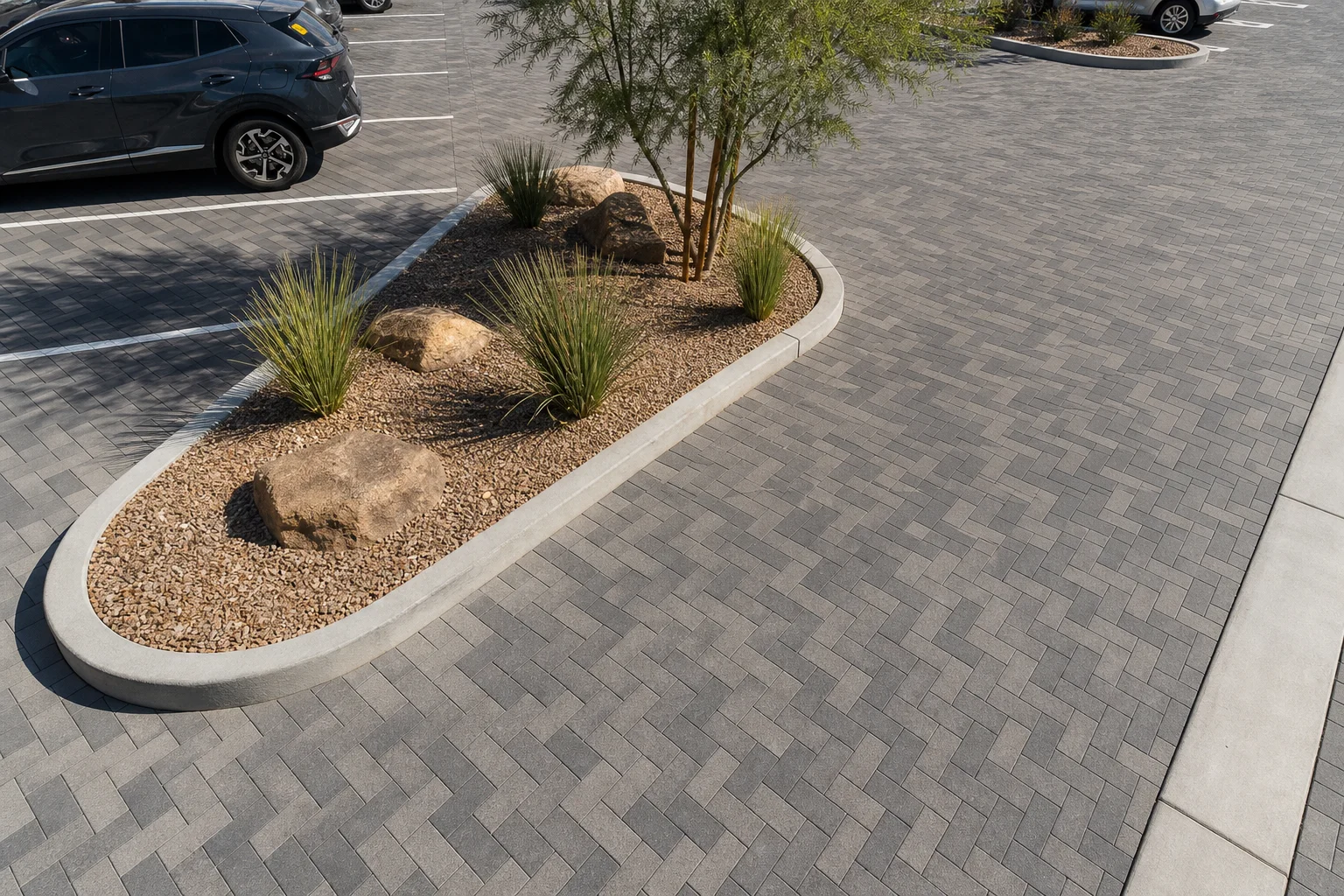
For a parking lot, the choice usually comes down to traffic pattern. A lot with consistent, distributed parking performs well with either material. A lot with a defined truck route, loading dock apron, or drive-through lane benefits from the segmented flex of pavers, since that pattern is most likely to stress a continuous surface over time.
Slip Resistance and Safety for High-Traffic Commercial Areas
Slip resistance matters for liability as much as comfort, and both surfaces can be finished to meet a safe traction standard when specified correctly. Concrete pavers get their texture from the manufacturing process itself, so grip is built into the unit and does not wear away the way a coating would. Stamped concrete relies on the stamp pattern plus a slip-resistant additive broadcast onto the sealer, and that additive needs periodic renewal, since a sealer worn smooth at an entrance can quietly turn a compliant surface into a liability exposure. Property managers choosing stamped concrete for its seamless look should confirm which slip-resistance rating a proposed finish meets, rather than assume a decorative pattern alone equals adequate traction.
Cracking and Repairs: What Happens When Damage Occurs
Stamped concrete is a monolithic slab, so when the ground beneath it shifts, the stress has to go somewhere, typically a crack that runs across the pattern and is hard to disguise. Control joints reduce this risk with planned break points, but they do not eliminate it. Concrete pavers are a masonry material assembled from individual units, so they do not crack the way a poured slab does; a paver can chip or crack from a heavy impact, but that damage stays contained to one unit rather than spreading.
A damaged paver can usually be lifted out and replaced with a matching unit, blending in once joint sand and sealer are reapplied. Stamped concrete is harder to spot-repair: color and texture are set at the pour, so a small patch often sits slightly off for years. Some cracks can be filled and camouflaged without replacing the full slab, but a structural crack, one that has shifted vertically or keeps widening, usually requires replacing the affected section.
Maintenance and ADA Compliance for Commercial Properties
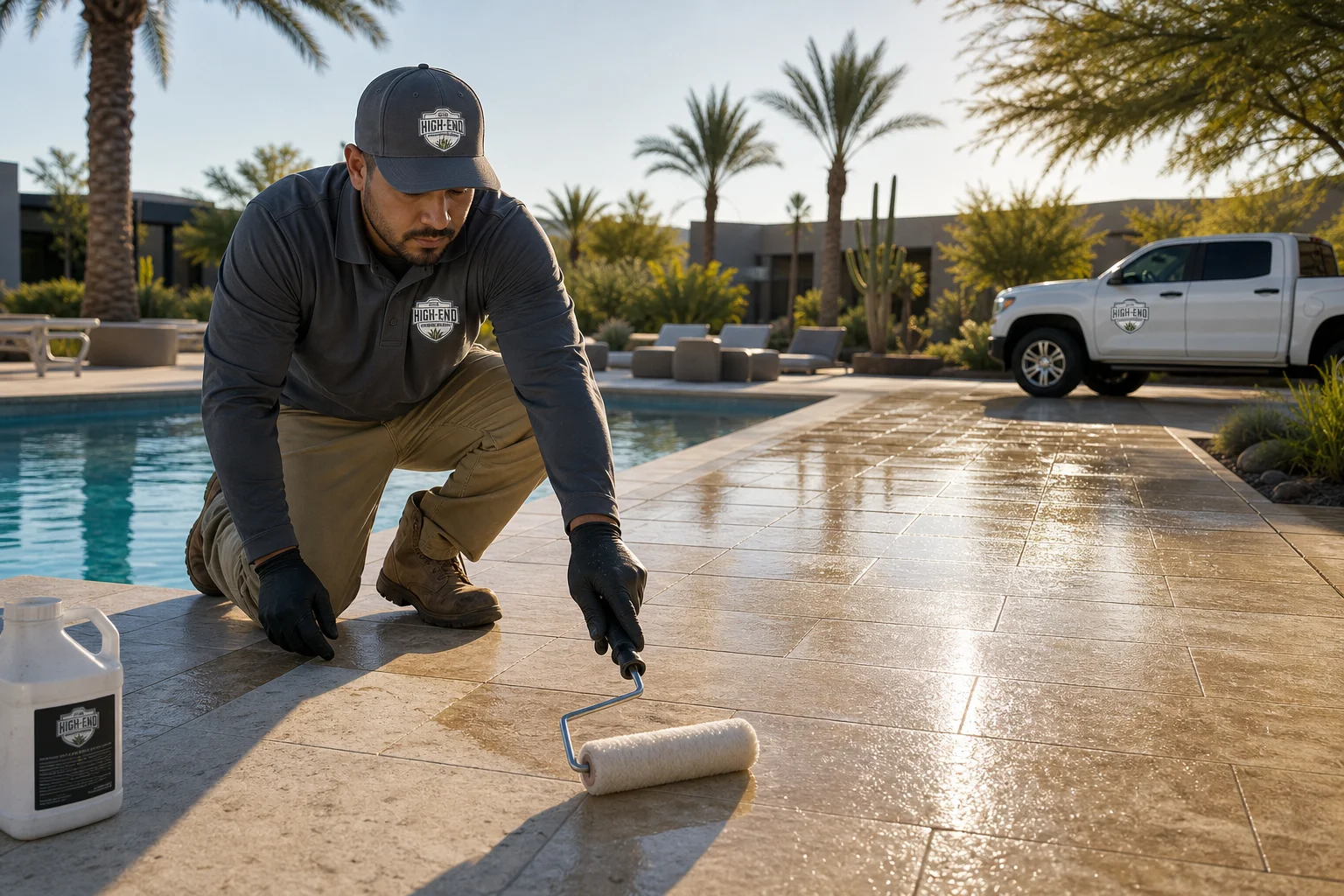
Concrete pavers need periodic joint sand top-off and resealing on a schedule tied to traffic and sun exposure, plus occasional weed or ant treatment in the joints. Stamped concrete needs resealing on its own schedule to keep color and slip resistance intact, and the sealer is the maintenance item most commonly skipped, also the fastest way to shorten the surface's usable life. Neither material is maintenance-free, and any property comparing concrete vs pavers should ask for a written resealing interval rather than a general estimate.
Both surfaces can meet ADA requirements for commercial walkways and entrances when installed to the correct surface flatness, joint width, and running slope. Pavers require joints narrow enough, and units flush enough, to avoid a trip or wheel-catch hazard, a detailing question rather than a limitation of the material itself. Because compliance depends on the specific entrance and local building code, confirm ADA detailing with your hardscape contractor and, where the surface adjoins a public right-of-way, with the jurisdiction's accessibility reviewer before finalizing a design.
Frequently Asked Questions
Is stamped concrete or pavers better for a commercial property overall? There is no universal answer. Pavers usually offer easier spot repair and less disruption during installation, while stamped concrete offers a continuous look some properties prefer. The better choice depends on traffic type, budget structure, and downtime the property can absorb.
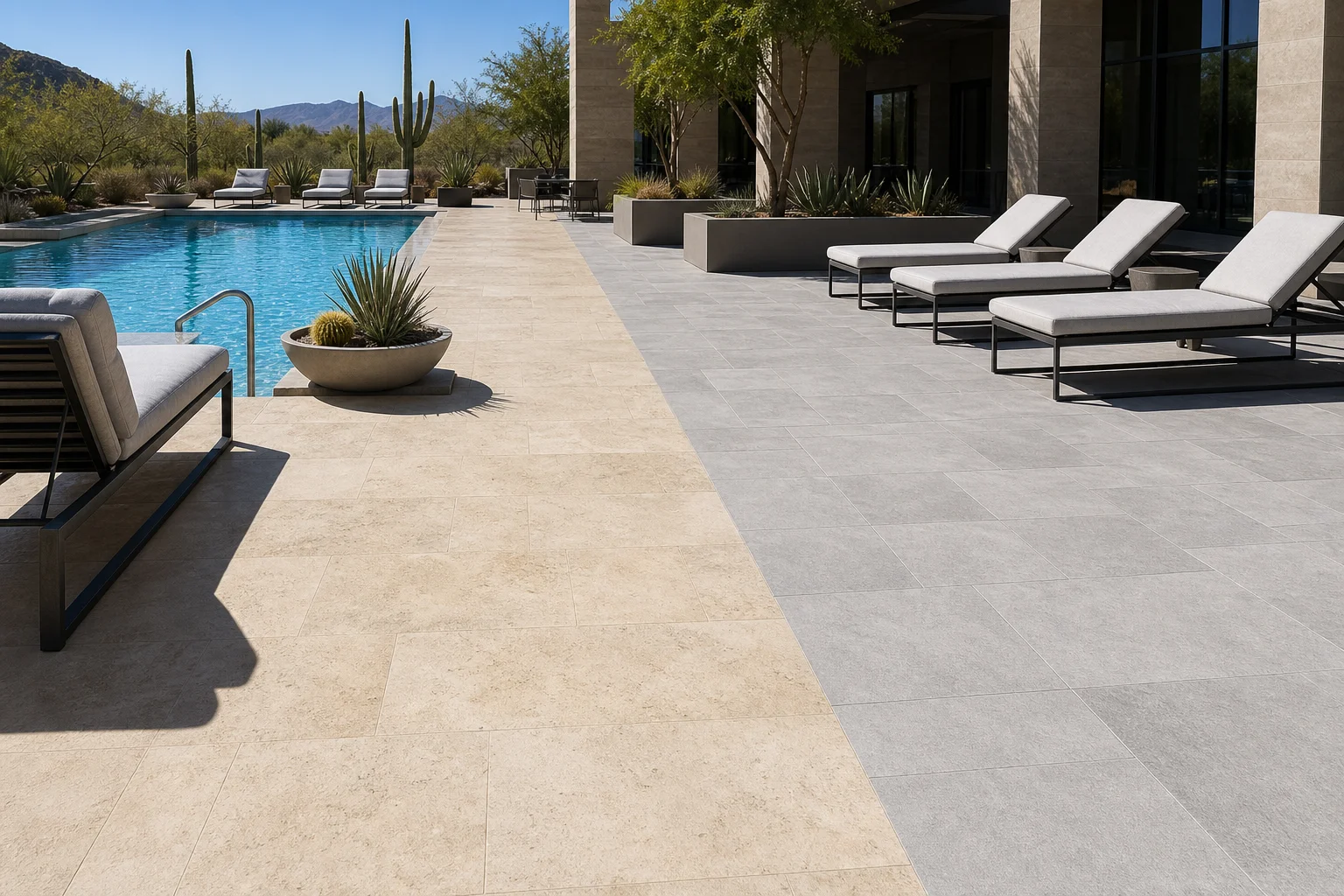
What colors and pattern options are available for each surface? Concrete pavers, including units cut from natural stone, come in a wide range of factory colors, shapes, and finishes that stay consistent unit to unit. Stamped concrete offers pattern and color flexibility through the stamp mold and integral or applied color, though colors can vary slightly across a large pour.
Do commercial pavers or stamped concrete affect liability exposure differently? Yes, in how damage shows up. A cracked paver is a contained, single-unit issue that is simple to flag and replace. A cracking or heaving concrete slab can create a wider trip hazard across a larger area before it is addressed, a factor property managers should weigh when setting inspection frequency.
Can pavers be installed over an existing concrete slab? In many cases pavers can be installed over a sound existing slab used as a base, reducing demolition costs. This depends on the slab's condition, drainage, and final height at doors and transitions, so it should be confirmed on site rather than assumed.
How do I know which surface fits my property's traffic pattern? The clearest way is a site walk that maps daily traffic, vehicle types, and problem areas like loading docks or drainage low points. That assessment, not a general rule of thumb, determines whether pavers or stamped concrete is the better choice for a specific project.
Get a Surface Recommendation for Your Property
Every commercial property carries a different traffic pattern, budget, and liability profile, and the right surface choice follows from those specifics. Contact HEOS AZ to walk your property and get a surface recommendation built around how it is actually used.