Playground Turf and Fall-Height Safety for Schools and Daycares
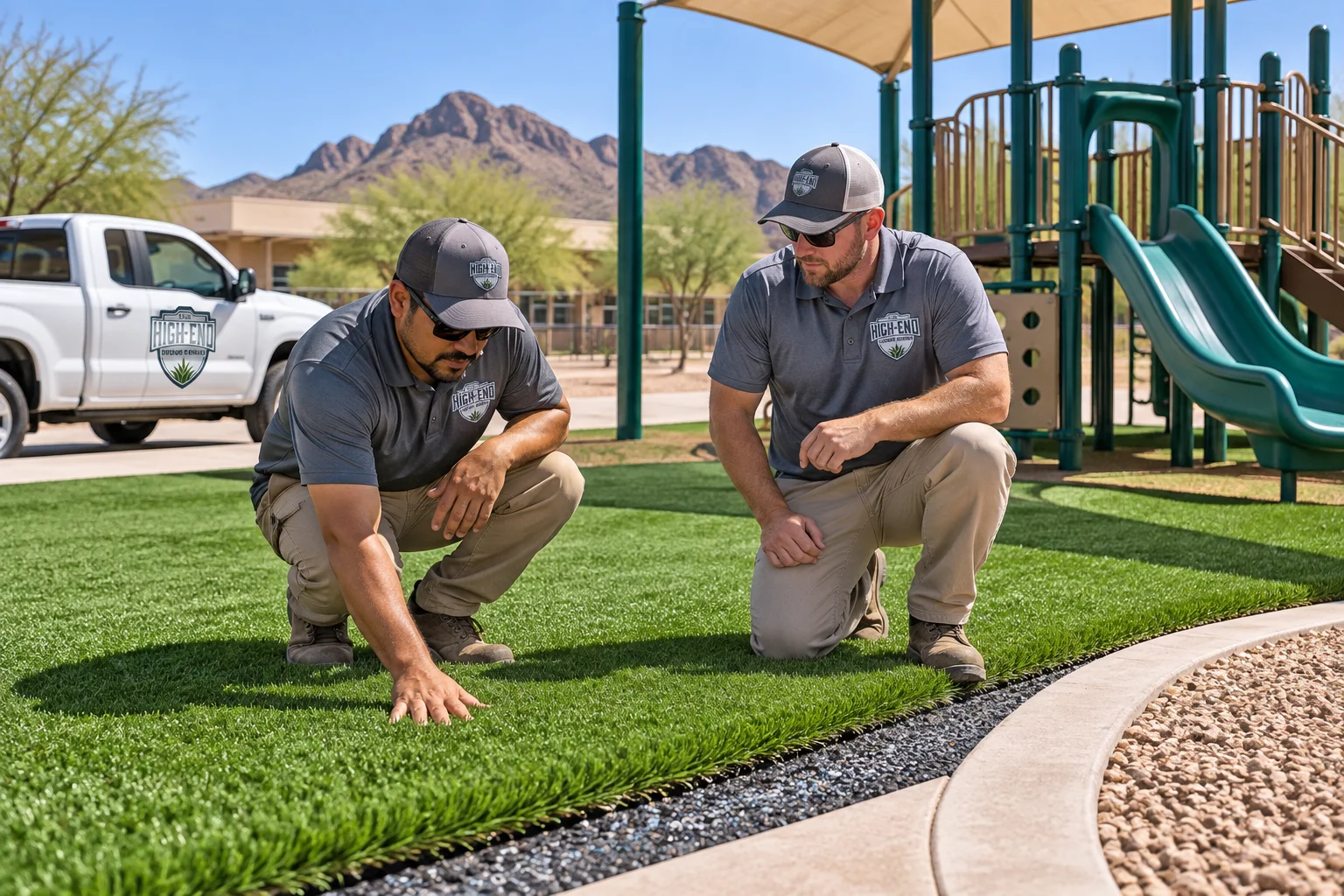
Schools and daycares evaluating playground artificial turf safety need a straightforward answer: yes, when the system is engineered and tested to a documented critical fall height, professionally installed as part of a certified Turf Installation, and maintained on a routine schedule, playground turf can meet the same safety standards required of any certified playground surface.
By HEOS AZ Team, Outdoor Living Specialists
Is Artificial Turf Safe for Playground Fall Heights at Schools and Daycares?
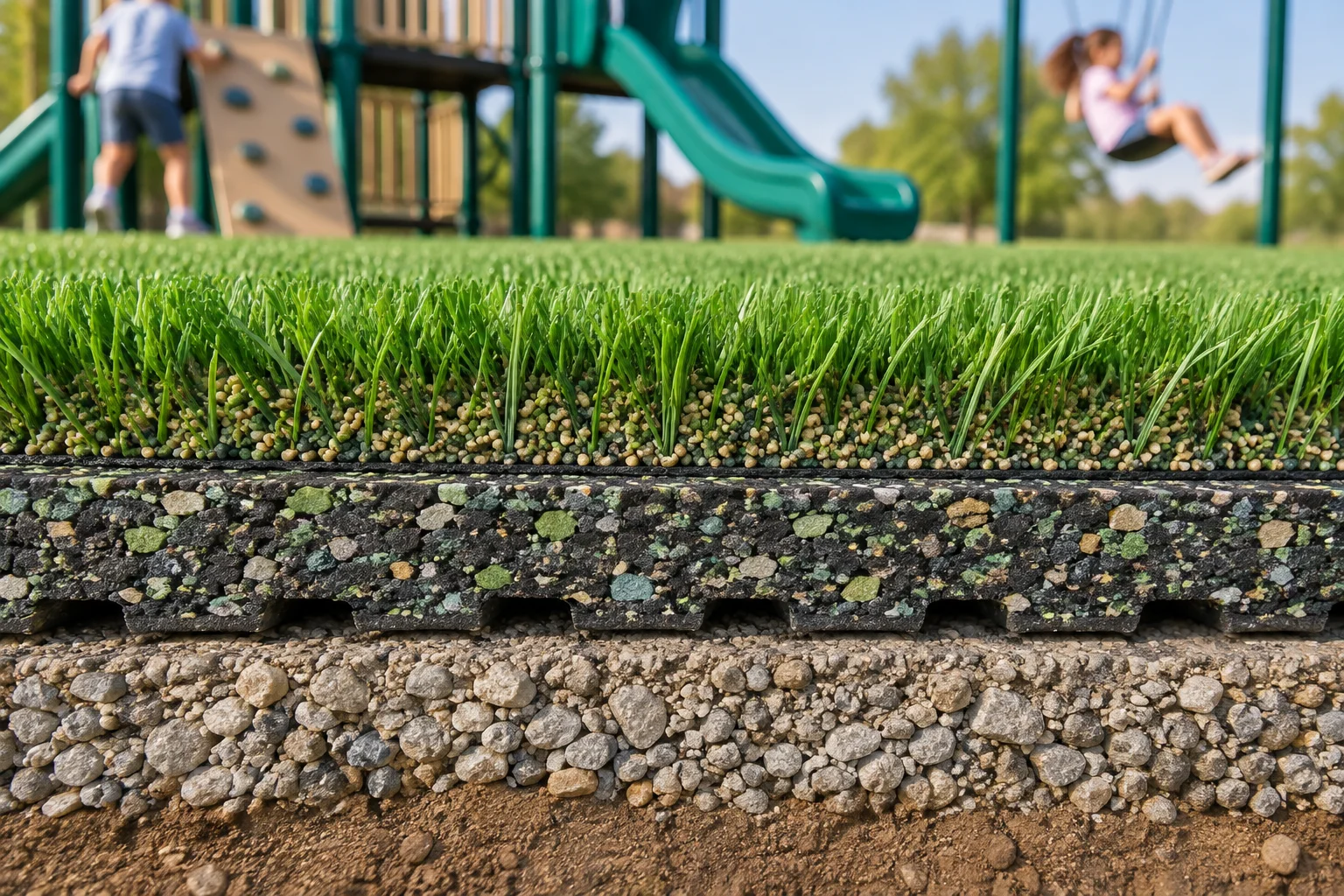
Playground artificial turf safety comes down to what sits underneath the artificial grass, not the turf face itself. A synthetic turf system is safe for playground fall heights when it pairs a wear-resistant turf face with an engineered shock pad and infill depth calibrated to the tallest equipment on site. Tested to ASTM F1292, the standard governing impact attenuation for playground surfacing, a properly built system absorbs a fall the way certified poured-in-place rubber or engineered wood fiber does. The turf face alone provides almost no cushioning: the padding beneath it does the safety work, so performance depends on installation quality, not the label.
What Is Critical Fall Height and How Is It Measured for Playground Turf?
Critical fall height is the maximum height a test headform can fall onto a surface without exceeding a GMAX rating of 200, the threshold used across most U.S. playground safety standards. Independent labs measure it with an instrumented drop test recording peak deceleration at each depth of infill and shock pad tested. The CPSC's Public Playground Safety Handbook uses critical fall height as the baseline for matching a surface to the equipment above it: taller equipment needs a higher-rated surface, and one playground often has multiple fall heights within a fall zone. Playground turf has to be tested and rated for that height range before a school or daycare can rely on it.
How Thick Does the Turf and Padding System Need to Be to Meet ASTM F1292?
Thickness requirements scale with the fall height a playground needs to cover. A shock pad rated for a 6-foot critical fall height typically runs thinner than one rated for 10 or 12 feet, and infill depth above the base adds further attenuation. As a general range, a bonded shock pad plus loose infill can meet ASTM F1292 requirements from about 2 inches for shorter equipment to 3 inches or more for taller structures, though the exact figure should come from the pad manufacturer's certified test report, not a generic chart. A compacted aggregate base and drainage layer beneath the pad keep water from pooling and softening it.
What Certifications and Test Reports Should School and Daycare Playground Turf Carry?
Before signing off on any playground turf installation, a school district or daycare operator should ask for three documents: a lab report confirming the system meets ASTM F1292 for its stated critical fall height, a spec sheet listing the shock pad and infill depth tested, and a site-specific GMAX test performed after installation, since lab ratings apply to the tested assembly, not automatically to how it is built in the field. Many state licensing agencies for daycares also reference ASTM F1487, the equipment standard, so the surfacing certification should be paired with proof the equipment layout matches the fall zones it was rated for.
Cost, Maintenance, and Long-Term Performance of Safety-Rated Playground Turf
How Much Does Safety-Rated Playground Turf Cost to Install?
Cost varies by fall height rating, shock pad specified, base preparation, and total play area square footage, so a reliable number comes from a site visit rather than a flat rate. Bids should be compared on the same fall-height rating and drainage and base work, since a lower bid that skips base compaction or substitutes a thinner shock pad will not perform the same way in a drop test. A school or daycare can request a free on-site estimate through Contact before budgeting.
How Do You Maintain Playground Turf So It Keeps Meeting Fall-Height Standards Over Time?
Infill settles and compacts under years of foot traffic, and that compaction is exactly what raises GMAX readings and can lower the fall-height rating a surface delivers. Routine maintenance, periodic infill grooming or top-up, debris removal, and drainage checks keep the padding system performing at its tested depth. Facilities that fold turf grooming into a broader grounds-care schedule catch problems before they show up on a GMAX retest.
Playground Turf vs. Poured-in-Place Rubber vs. Wood Mulch: Which Surfacing Is Safest?
All three playground surfaces can meet ASTM F1292 when installed and maintained to spec, so safest comes down to which system holds its rating with least upkeep. Wood mulch, or engineered wood fiber, is least expensive but compacts quickly, migrates out of the play area, and needs frequent replenishment. Poured-in-place rubber holds its attenuation consistently and needs little topping up, but it is the most expensive system and can be hard to repair without a visible patch. Playground turf with an engineered shock pad sits between the two: it holds its critical fall height better than loose mulch, drains faster in Arizona's monsoon season, and costs less over time than poured rubber, provided the padding is inspected on schedule.
Equipment Height Limits, ADA Access, and Testing Frequency
What Is the Maximum Equipment Height Allowed Over a Given Playground Surface?
There is no single maximum height for playground equipment; instead, ASTM F1487 and the CPSC handbook require the surface beneath equipment to be rated for a critical fall height equal to or greater than its highest play surface. A 6-foot slide platform needs a surface tested to at least a 6-foot critical fall height, and a 10-foot climbing structure needs the surface rated accordingly, so playground turf has to be specified by height range during design. Many of the same base, drainage, and shock-pad principles used for multi-use turf fields at schools carry over to playground applications.
Does Playground Turf Meet ADA Accessibility Requirements for Schools and Daycares?
Playground turf can meet ADA accessibility requirements when installed as a firm, stable, slip-resistant surface across accessible routes and use zones, the standard ADA Accessible Design applies to play components. A compacted base and turf without excessive give underfoot generally perform better for wheelchair and walker access than loose mulch or pea gravel, though the route layout still needs verification against ADA guidelines.
How Often Should Playground Turf Be Tested for GMAX and Fall-Height Compliance?
Many playground safety standards and state licensing programs recommend a GMAX retest at least once a year, with an additional check after major weather events or infill top-ups. Compliance is a moving target, since UV exposure, compaction, and drainage changes can shift a rating between tests. Facilities that document each retest build a defensible compliance record if an incident is ever reviewed.
Frequently Asked Questions
Does playground turf get too hot for kids in Arizona? Synthetic turf can run hotter than natural grass in direct summer sun, similar to any dark paved or rubber surface. Light-colored infill, shade structures, and periodic watering during peak heat noticeably reduce surface temperature. Facilities in Arizona typically pair turf playgrounds with shade sails or tree canopy over the busiest zones.
How long does safety-rated playground turf typically last before it needs replacing? A quality playground turf system, properly maintained, generally performs for 8 to 15 years before the turf face needs replacing, though the shock pad underneath often lasts longer if kept clean and drained. Lifespan depends on traffic volume, UV exposure, and how consistently infill and drainage are maintained.
What happens if a playground surface fails its GMAX test? A failed GMAX test means the surface no longer meets its certified critical fall height and needs corrective action before it can stay in use, such as adding infill depth, replacing a compacted shock pad, or improving drainage. Facilities usually restrict access to the affected zone until a retest confirms it is back within rated range.
Is poured-in-place rubber required by law for school playgrounds? No single surfacing material is mandated by federal law. ASTM and CPSC guidelines require the surface, whatever the material, to be tested and rated for the site's critical fall height, and playground turf, poured-in-place rubber, and engineered wood fiber can all satisfy that requirement when properly engineered and documented.
Keep Your Playground Turf Compliant Year After Year
A fall-height rating only holds if the system underneath the turf is inspected, groomed, and retested on schedule, and that upkeep is easiest to maintain when built into a property's regular grounds care. Ongoing Commercial Maintenance keeps compaction, drainage, and infill depth on track between GMAX retests, so the certification a school or daycare starts with is still true years later.