KPIs and Reporting: How Property Managers Should Measure a Landscape Vendor

Property managers who rely on guesswork when evaluating landscape vendors leave quality, budget control, and resident satisfaction at risk. KPIs and reporting provide the concrete benchmarks needed to hold vendors accountable, justify maintenance budgets, and make informed decisions about your Commercial Maintenance program before renewal conversations begin.
By HEOS AZ Team, Outdoor Living Specialists
Why Formal Measurement Matters in Commercial Landscaping
A landscape vendor can appear productive and still fall short of your property's actual needs. Without a structured reporting framework, minor service gaps accumulate invisibly: missed edging on high-visibility corridors, irrigation zones that cycle outside their programmed windows, or tree clearances that drift below required thresholds before anyone notices.
Formal vendor measurement shifts accountability from anecdotal observations to documented performance. It creates a shared language between property managers, HOA boards, and the service provider. When everyone reviews the same kpi reports, service expectations stop being a matter of interpretation.
Arizona's commercial landscape environment adds complexity that generic vendor scorecards cannot address. Extreme heat, monsoon variability, and water-efficiency mandates mean your performance indicators must reflect local conditions. A Scottsdale HOA community has different thresholds for turf health, irrigation performance, and seasonal response times than properties in cooler climates.
KPIs and Reporting: The Key Performance Indicators That Matter Most
The goal of identifying key performance indicators is to choose metrics that are observable, repeatable, and directly tied to property outcomes. The following represent the most reliable performance indicators kpis for commercial landscape contracts:
Service Completion Rate. This tracks the percentage of scheduled visits completed on time and in full. A vendor performing 90 percent of scheduled services while leaving 10 percent unfinished without notice creates compounding maintenance debt.
Work Order Response Time. How quickly does the vendor respond when a property manager submits a reactive request? This indicator separates vendors who treat service agreements as a baseline from those who treat them as a ceiling.
Irrigation System Uptime. In Arizona, irrigation failure directly affects plant health and water costs. Tracking uptime and leak events per quarter ranks among the most critical key performance indicators for desert properties.
Turf and Plant Health Ratings. A scored visual inspection of turf coverage, color uniformity, and ornamental health produces objective data where subjective impressions once dominated.
Safety and Compliance Incidents. Track reported incidents, near-misses, and code violations per period. Properties that fall below acceptable safety thresholds should see this reflected clearly in every report kpi.
Resident or Tenant Feedback Score. Aggregated responses from satisfaction surveys offer a measure performance dimension that purely operational metrics cannot capture. The Institute of Real Estate Management (IREM) identifies resident satisfaction as a core property management metric in its professional standards curriculum, making it a defensible addition to any vendor scorecard.
For gated and planned communities, Landscape Maintenance for Gated Communities: Scope, Frequency and Standards covers how scope definitions affect which indicators kpis to prioritize by community type.
How to Structure Your KPI Report
Effective kpis and reporting begins with understanding what each section of the report is supposed to accomplish. A well-built kpi report does more than list numbers. It tells a story: where the property stands this period, how it compares to the previous period, and what action is required.
Structure each report kpi around three segments:
Executive Summary. One paragraph covering the period's overall performance. Designed for board members or asset managers who need context without operational detail.
Metrics Dashboard. A table or visual grid showing each key performance indicator, the target, actual result, and trend direction. Keep this section scannable.
Action Items. Any metric that missed its target should generate a specific remediation step with an owner and due date. A kpi report without action items is a historical document, not a management tool.
Reporting cadence matters as much as structure. Monthly kpi reports suit Arizona's active maintenance season, generally October through May. Quarterly reviews are acceptable during slower periods, provided your contract includes provisions for unscheduled visits during monsoon recovery windows.
For properties with complex maintenance scopes, What a Commercial Landscape Maintenance Contract Should Include explains how contract language should connect directly to your reporting framework, removing ambiguity about what is being measured.
Building Dashboards and Shared Reporting Access
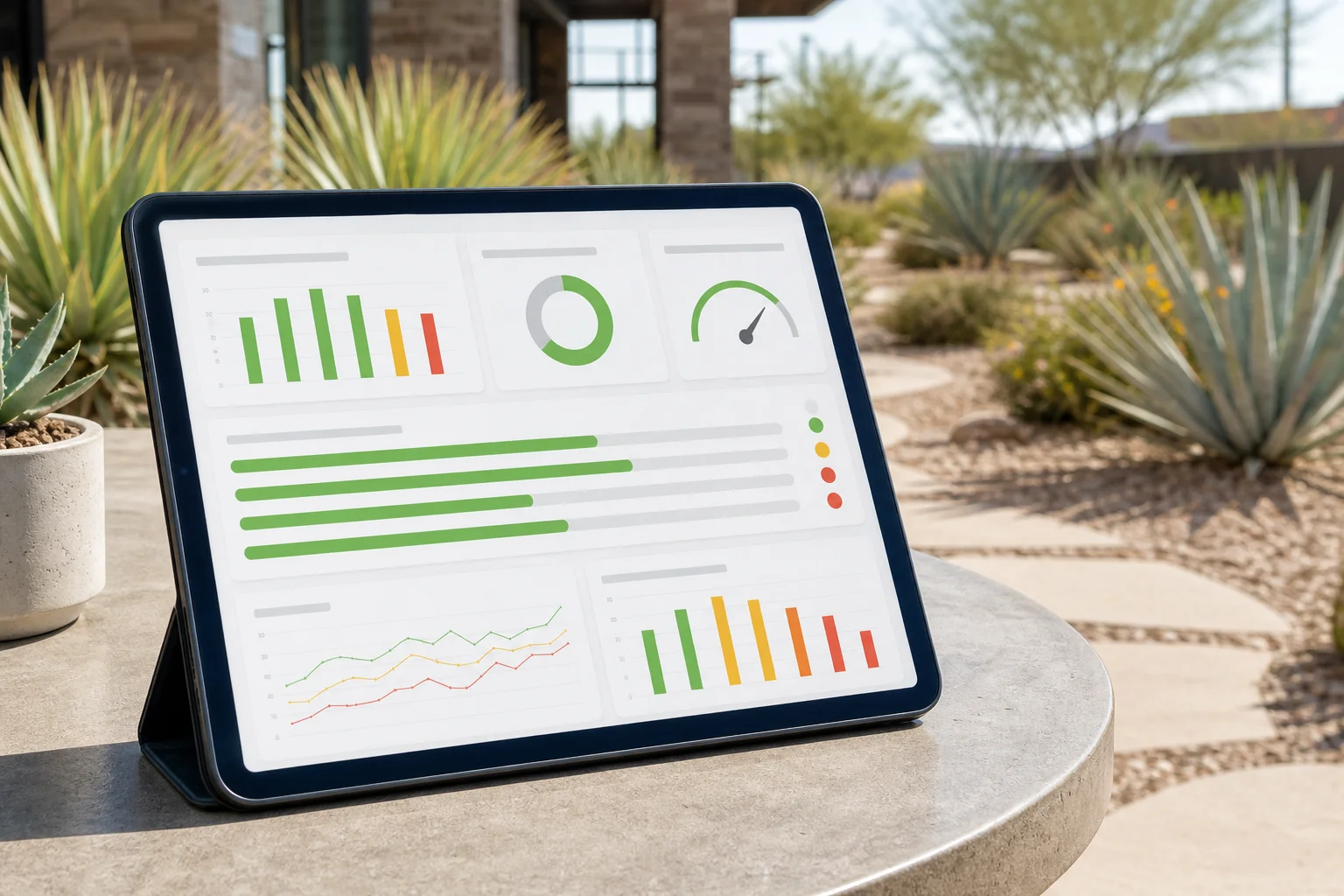
The link between kpis and reporting and your vendor's technology platform is direct. Professional landscape vendors operating at a premium level provide digital reporting access, not quarterly PDFs delivered on request. Reports dashboards that give property managers real-time visibility into service events, photo documentation, and trend analytics represent the current standard for commercial accounts in the Phoenix metro.
When evaluating a vendor's reporting infrastructure, ask the following:
- Can you access service logs between formal report cycles?
- Does the vendor provide photo verification of completed work?
- Are reports dashboards formatted for board presentation without reformatting?
- Can you filter data by zone, crew, or service type?
Vendors who cannot provide accessible data between reporting cycles force property managers into a reactive posture. Analytics available only on vendor request shift control away from the client and toward the service provider.
HOA Landscaping boards benefit most from vendor platforms that produce board-ready analytics because finance committees increasingly expect the same transparency from landscape spend as from any other operating budget line.
Using Data to Make Informed Decisions at Renewal
Twelve months of kpis and reporting data transforms a vendor review from a conversation about impressions into a conversation about facts. The most valuable function of ongoing key performance indicators kpis is what they enable at contract renewal. When a property manager enters a review meeting with documented data, informed decisions replace subjective impressions.
Structured data allows you to:
- Identify patterns in service failures versus isolated incidents
- Quantify the cost of missed visits against the contract rate
- Compare vendor performance across multiple properties in your portfolio
- Build defensible case studies for board presentations
For properties considering a vendor transition, Implementing Effective Landscape Maintenance Programs for Commercial Properties outlines how to structure a change without disrupting ongoing maintenance quality.
How Often Should Commercial Properties Be Serviced? The Arizona Maintenance Calendar also provides the baseline service frequency data needed to set realistic targets for your key performance indicators.
Frequently Asked Questions
What is a KPI report for a landscape vendor?
A kpi report for a landscape vendor is a structured document tracking agreed-upon performance indicators across a set period, typically monthly or quarterly. It includes metrics such as service completion rate, irrigation uptime, and plant health scores, then compares actual results to established benchmarks. It serves as the primary accountability tool between property managers and their landscape contractor.
How many key performance indicators should a property manager track?
Most effective vendor scorecards use between five and eight key performance indicators. Fewer than five misses important dimensions of service quality. More than ten creates reporting fatigue and dilutes attention from the metrics most directly tied to property outcomes. Choose indicators aligned to your property type, whether commercial office, HOA, or mixed-use community.
Who should receive the KPI reports?
For HOA-managed communities, boards and finance committees typically receive the executive summary, while property managers and facilities staff receive full operational detail. The landscape vendor should receive the complete report at every cycle, including action items, to maintain shared accountability and give the vendor a clear path to improvement.
Can the same reporting framework work for landscaping and other property vendors?
Yes. Some property management platforms allow you to measure performance across all service vendors using a unified scorecard. Landscape-specific key performance indicators need to be adapted to reflect horticultural and site-condition factors, such as turf health ratings and irrigation uptime, that differ from building maintenance or security metrics.
What should happen when a vendor consistently misses KPI targets?
A single missed period warrants a documented conversation and a remediation plan with clear milestones. Consistent failure across two or more periods is grounds for a formal contract review. The goal of key performance indicators is to create an improvement pathway, not to build a termination file. When course correction does not occur despite documented support, the data provides a rational basis for transition planning.
Set a Clear Standard for Your Arizona Property
Property managers who invest in structured kpi reports and a formal reporting cadence consistently get more from their landscape vendors and spend less time resolving service disputes. If your current vendor cannot produce transparent data or participate in a defined reporting cycle, that gap is worth addressing now. Community Landscaping at the commercial level demands the same accountability as any other major operating expense, and the right vendor will welcome the structure.